RSS

Deoband Advises Muslims Against Second Marriage

Muzaffarnagar , Islam on Rise April 13 2012:
Leading Islamic seminary Darul Uloom Deoband has appealed to Muslims not to marry for the second time since it is hard to provide “equal justice” to two wives in “Indian custom”.
“It is hard to provide equal justice to two wives in Indian custom,” it said, replying to a query by a person who wanted to marry a second time while his first wife was alive.
“Though Islam permits two wives at the same time, Indian tradition does not allow it,” the seminary said.
Moreover, the husband generally cannot do justice and cannot maintain equality between the two wives.
Hence, he may have only one wife as the Quran has said. You should discard the idea of a second marriage, otherwise you will feel sorry,” the Darul Ifta said.
Often girls from poor families would stay unmarried because of financial constraint. So, rich men were allowed to marry up to four times. But times have changed. Now Muslims are conscious about their economic condition and act accordingly
President of Uttar Pradesh Imam Organisation, Mufti Zulfikar said though Islam allows for second marriage on the condition that the husband ensures equal maintenance, “it is difficult to provide same treatment to both women”.

Blind by birth, Ramiz memorizes Quran at 16

(Jan 27 Islam on Rise): Nothing is impossible if one feels strongly about and struggles consistently towards it. It’s the story of Ramiz Vohra, 16, a blind boy from Nadiyad district of Gujarat who memorized the whole Quran.
Ramiz was born in a poor family of Kanjari village in 1996. His father Farooque Vohra is a hawker and sells cloths from door to door. He came to know after his birth that Ramiz is blind. Naturally he might be upset but Ramiz made him proud.
He was blind but an intelligent boy. He started going to school and also to Madarsa to learn Arabic. He was very much interested to become a Hafiz and started his journey at the age of 13 years.
Sharing his experiences Ramiz said, “I used to sit with my friends who were memorizing Quran. When teacher heard their lessons, I sat with them and memorized it. I also memorized the corrections made by the teacher. Thus Alhamdulillah, I learnt Quran in three years time.”
The family members, teachers and villagers are happy and proud of Ramiz. Salma Vohra, his mother said: “We are proud of Ramiz. He has also been honoured by Mufti Ahmed Sahab Khapuri for his achievement.”
Ramiz said, “I have become Hafiz (who memorized the whole Quran is called Hafiz) and now am aiming to go ahead and learn Alimiyat and Mufti in the next 9 years since my elder brother is learning Alimiyat.” Hafiz Ramiz will be Mufti Ramiz in the coming years.
(In the picture Ramiz Vohra with his father and mother)

This May Be Your Last Ramadaan...!

All praise is due to Allah Ta'ala, may peace and salutations be upon His Messenger (sallallahu alayhi wa sallam), his household and companions. We are once again blessed with the Honourable month of Ramadaan. A month for renewing our faith, strengthening our willpower, and seeking forgiveness, a unique opportunity to strengthen the bond of love with our Creator, through fasting, recitation of the Quran, Taraweeh salaah, and through acts of charity.
People approach Ramadaan in different ways. Ramadaan means different things to different people. Some people view Ramadaan as a period of expressing their undying love for the Beloved. For them, Ramadaan is a valuable, precious, and rare occasion. They spend all their time doing good, convinced that the reward of each act is
multiplied manifold. Patience, sympathy, and generosity beautify the demeanour. They guard their tongues and remain preoccupied in chanting Laa ilahaa illallah, seeking forgiveness, begging for Jannah,
and seeking protection from Jahannam. They are driven by the words of Rasulullah (Sallallahu alayhi wa sallam) that say:
“The fish in the sea, seek forgiveness for them until they break their fast. Everyday Allah decorates Jannah for them and says to it: The time is near when my faithful servants shall cast the great trials (of the world) and come to you... On the last night of Ramadaan they are forgiven..." (Ahmad)
There are others who 'welcome' Ramadaan with sighs of reluctance. To them Ramadaan is an unfair imposition, a month of deprivation and hardship. They grudgingly keep fast and drag themselves to the Masjid for the Taraweeh prayer. Their concept of fasting is limited to physical abstention of food, drink, and sexual relationship. They spend their time in gossip, watching sport, and wasting their nights parked at cafe corners and restaurants. They are hardly ever stirred to Tilawah, Zikr, and dua, nor are they careful of their salaah. Their goal in Ramadaan IS to prepare for Eid. The words of Rasulullah(sallallanu alayhi wa sallam) aptly describes their spiritless endeavours: " Many are the ones who fast attaining nothing by such fasting except hunger , and many perform salaah by night attaining nothing by it except the discomfort of staying awake." (Ibn Majah)
Rasulullah (sallallahu alayhi wa sallam) further stated that: " Allah does not require the discarding food and drink of the person who fasts but does not refrain from bad speech and action." (Sahih Bukhari)
There is yet a third group who is hardly ever moved by Ramadaan. They neither read salaah, nor fast. They continue living recklessly in sin. They neither have the will or the time to make any sort of change in their dai Iy routines. The following words of Rasulullah (sallallahu alayhi wa sallam) should serve as a grim reminder to them: " ...Jibraeel (alayhis salaam) appeared before me and said: " Woe to him who found the blessed month of Ramadaan and let it pass by without gaining forgiveness." Upon that I said:
Aameen. (Sahih Bukhari) He also said: "Whoever does not fast for even one day in Ramadaan, without a valid excuse, shall never be able to repay that day even if he fasts for the rest of his life" (Ahmad)
Brothers and sisters in Islam! Fear Allah Ta'ala and beware of wasting your life away in futile activities. Make use of your time by being positive and constructive, for it is by doing so you can achieve the pleasure of Allah Ta'ala. This may well be your last Ramadaan, your last opportunity to benefit from the special blessings and forgiveness that accompanies this month. Know that Ramadaan is a manifestation of Allah Ta'ala's bountiful blessings on His slaves. Use it as a turning point in your life; a time for transformation towards a better way of life; a change from the ignominy of sins to the glory of obedience; from weakness and laziness to strength and vigour; from bad customs and detestable habits to righteousness and upright conduct.
Resolve 0' Honourable Muslim!
• To perform the five daily salaah with the congregation,
• To perform the Taraweeh salaah diligently.
• To spend as much time as possible in dua, Tilawah, and Zikr
• To take part in the various Ramadaan programmes at your Masjid.
• To protect your fast by guarding your tongue, eyes, and thoughts.
• To beautify your fast by sharing your iftaar with your neighbours and the needy.
• To be patient, tolerant, and sympathetic. Especially to your parents and spouse.
• To be kind and generous to the poor and needy. Especially to our destitute Muslim brothers and sisters from foreign countries.
• To serve at least one sick, aged, or disabled person during this Ramadaan.
• To make dua for the Ummah daily before iftaar.
May Allah Ta' grant us the faith, strength, and spirit to make this a unique and special Ramadaan. May He grant us the ability to be consistent in our endeavours. May He protect and preserve our faith.

Vastanvi removed as Deoband University VC

Deoband July 24: Ghulam Mohammad Vastanvi has been removed as the Vice Chancellor of Darul Uloom Deoband University after getting eight votes against him at the Deoband meeting.
Vastanvi, who refused to resign from the post of Vice Chancellor, got five votes in favour and eight against him.
"I am bidding farewell to Darul Uloom. I told the committee that I will not step down but they can remove me if they deem it fit," Vastanvi said.
He alleged that the report submitted before the committee is not complete and refused to accept an incomplete report.
"The students of Darul Uloom are not against me but a section of the students were being brainwashed by a few," he said.
Vastanvi sparked controversy in February, 2011 when he said that Muslims had benefited from the development initiative of the Gujarat Chief Minister Narendra Modi. He later denied to have said this.


Vastanvi removed as Deoband University VC

Deoband July 24: Ghulam Mohammad Vastanvi has been removed as the Vice Chancellor of Darul Uloom Deoband University after getting eight votes against him at the Deoband meeting.
Vastanvi, who refused to resign from the post of Vice Chancellor, got five votes in favour and eight against him.
"I am bidding farewell to Darul Uloom. I told the committee that I will not step down but they can remove me if they deem it fit," Vastanvi said.
He alleged that the report submitted before the committee is not complete and refused to accept an incomplete report.
"The students of Darul Uloom are not against me but a section of the students were being brainwashed by a few," he said.
Vastanvi sparked controversy in February, 2011 when he said that Muslims had benefited from the development initiative of the Gujarat Chief Minister Narendra Modi. He later denied to have said this.


Latest propaganda against Deoband: Seminary demands a probe

Patna: It was shocking and surprising for Darul Uloom Doaband, which issued a fatwa against terrorism and organized a national level conference of Islamic scholars to condemn the terrorism, when the news floated that an email is being circulated on internet by so-called ‘Tahreek-e-Taliban Hindustan’ which used the name of the seminary urging Muslim youths to indulge into anti-state and nation activities.
According to the news the email says: “India was never Hindus’ country. Muslims ruled over it for centuries. So, we Tahreek-e-Taliban Hindustan’ demand that in the areas where Muslims are in majority, there would be Muslim’s rule and Hindus of these areas will have to pay jiziya.”
Taking serious notice of this malicious report, the seminary strongly condemned the news. It not only clarified its stand on terror distancing itself from any such anti-nation organization and group but also wrote to Union Home Minister, P. Chidambaram demanding probe into the matter.
Talking to Islam on Rise on phone, Deputy Rector of the seminary, Maulana Abdul Khalique Madrasi said: “We have written today to the Home Minister demanding a thoroughly investigation into the whole dilemma to probe people and group behind this filthy and undemocratic deed to defame the name of the seminary which has always been advocating communal harmony and peace.”
In his reaction, Acting Rector of the seminary Maulana Abul Qasim Nomani while condemning the ongoing propaganda said: “How Darul Uloom Deoband can propagate such idea while it has a long history of promotion of Hindu-Muslim unity and secularism?”
Terming the news as propaganda to malign the name of the seminary, Maulana Nomani said: “We are against the terrorism in all its forms it’s against the teachings of Islam which is religion of love and peace. But some communal minded and extremists groups have always been making efforts to disturb the peaceful atmosphere of the country and decline the Hindu-Muslim unity for their personal benefits. This latest propaganda is part of that filthy game using the name of Darul Uloom Deoband.”
He appealed to people not to give heed towards such baseless report against the institution. “We also demand government to direct investigation agencies to find out the mischievous people who are doing such dubious acts and punish the guilty” he added.
He said people should read the history of the institution and its scholars: “In 1912, when Deobandi scholars under the leader of freedom fighter Shaikhul Hind Maulana Mahmood Hassan, announced a war for independence against British government, they named Raja Mahendra Pratap as president of the ‘free India’. Later, when India got freedom the seminary strongly went against Mohammad Ali Jinnah’s Muslim League’s two-nation theory and then rector of Deoband, Maulana Hussain Ahmad Madni opposed the partition.”
He said that many non-Muslims historians like Dr Tara Chand, Dr Ishwari Prasad and Dr K.M. Panicker mentioned the seminary’s contribution to strengthen the social and secular fabric of the country.
According to Maulana Nomani, besides online campaign against the seminary, Hindi daily Hug Dharam and Marathi daily Paran Nagri, both published from Nagpur, carried out the news on July 16 alleging the seminary to have terror link which is very unfortunate.
Despite its unblemished history of contributions for the country, the attempt to defame Daarul Uloom Deoband and to link it with terror had always been carried out. The RSS and VHP leaders have been crying foul against the seminary. The latest effort is very dangerous in the wake of Mumbai serial blast in which only Muslims are being suspected. Is this campaign to link the most influence Islamic seminary with the recent blast?
It should be noted here that Darul Uloom Deoband issued fatwa declaring terrorism in all its forms un-Islamic. In addition to it, in February 2008, Darul Uloom Deoband organized an anti-terror national conference attended by thousands of Islamic scholars who unanimously condemned the terror act. It was the time when country was witnessing several blasts

Creating Islamic awareness is the prime objective of Islamic Online University (IOU): Mohammed Shajiuddin

Islam On Rise: 06 June 2011
Mohammed Shajiuddin, an Osmania University graduate, who served at the King Fahad University of Petroleum & Minerals, Saudi Arabia, is the India representative of Islamic Online University (IOU). He was in Delhi recently. Manzar Imam spoke with him about IOU.
Excerpts of the interview.
MI. How did IOU come into existence?
MS. The idea of the online Islamic University was conceived by Dr Abu Ameenah Bilal Philips. He started the university in 2007 in Qatar where it has its international head quarters.
MI. There are many universities offering courses in various Islamic disciplines. Why IOU?
MS. Changing the nation through education is the motto of its founder. Times have changed. Youths are turning professionals. Many Muslims do not get time to understand Islam. Their life schedule does not allow them time to read Islamic books and understand Islam. It was thus decided to start online courses which could be easily covered during spare times. People are familiar with computers now, hence an online course would be suitable.
MI. Which courses do you offer?
MS. At present, IOU has 26 diploma courses which are free of cost. In March, 2010 we started a four-year B.A. programme in Islamic studies. The only condition for admission to this course is a 10+2 certificate. For diploma courses no formal academic qualification is required.
MI. What response do you get?
MS. In B.A. and other diploma courses we have 5000 students in India. Globally, the number of students in our different courses is more than 40000 in 197 countries. The highest response we have got is from America followed by India.
MI. What are your future plans?
MS. The response in India is positive. With head quarters at Hyderabad, we have centres in Coimbatore, Kerala, Bangalore, Mangalore and Kashmir. Now we have entered an agreement with Islamic Da’wah Centre in New Delhi. The registration for our September semester is open. We are planning further expansion.
MI. What is the course structure of B.A. Islamic Studies?
MS. Most of the course-related and other information are available online on our international website www.islamiconlineuniversity.com and also on our local website www.iouindia.com. The B.A. course is spread over 8 semesters. It is a four-year course but one may complete it in minimum 3 years duration. It teaches Tajweed (Arabic phonetics) for better Quranic recitation, Fiqh, seerah, English and Arabic language, Islamic history and civilization, and introduces Islamic principles to students.
MI. You have signed an agreement with Islamic Da’wah Centre, Delhi and have other centres too. What is their role?
MS. We have many examination centers only for conducting examinations. There are few recognized centres with infrastructure and capacity to run our diploma, undergraduate and graduate courses. IDC, Delhi is one of them. The IOU centres would conduct examinations and also promote the university in their area of operation.
MI. Any specific objective of this course?
MS. There is a growing lack of awareness among Muslims youth about their religion which is often negatively represented. Although the course is open to all with no distinction of region and religion, we aim to educate Muslim professionals about Islam.
(A Delhi-based journalist Manzar Imam can be reached at manzarkhalil@gmail.com)
(In the picture Mr Shajiuddin with Manzar Imam)

Islam arrived in Manipur, India in 615 CE through companions of Prophet Muhammad (PBUH): claims a book

June 03, 2011
A book released recently in Manipur, titled "Manipuri Muslims: HistoricalPerspectives 615-2000 CE," authored by Farooque Ahmed, claims that Islam arrived in the region in 615 CE through Saad ibn abi Waqqas and Amir Hamza, uncles of Prophet Muhammad. According to Farooque Ahmed, Aribam, a Muslim clan (sagei) in Manipur, traces its biological ancestry to Amir Hamza and Saad ibn abi Waqqas. He writes: “It is an accepted fact that the Aribam section of Manipuri Muslims traces its biological ancestry to Hamza (567-625 CE), the paternal uncle of prophet and Saad ibn abi Waqqas (d. 647 CE), the maternal uncle of the prophet.” He also writes about a theory that the term “Aribam” is believed to have been derived from the Arabic word “Aribah” meaning “pure Arabs.”
Farooque Ahmed also writes that Hamza reached Manipur before 610 CE and “Waqqas was among the three sahaba who reportedly left Abyssinia by sea on way to China in 615 CE and reached Manipur via Chittagong port in that year itself.” He also writes that Muhammad Hanifa, the eldest of the two sons born to Caliph Ali and his second wife Khawla bint Jafar, fled to Arakan in 680 CE after he lost the struggle for Caliphate and founded an Islamic community. Muhammad Hanifa paid a visit to Manipur and met the local Muslims, he further claims.
Farooque Ahmed also writes that the Muslim saint (Pangal Musalman Guru) who preached in Manipur during King Nawphangba’s reign in the first decade of the 7th century, as mentioned in the local ,em>puyas (archaic texts), could have been either Saad ibn abi Waqqas or Hamza. He writes: “Evidences indicate that this “guru” was a saintly man. Yet if the Manipuri king reined till 624 CE, this saint could have been either Saad ibn abi Waqqas or Hamza, both of whom were uncles of the Holy Prophet Muhammad. Amir Hamza whom the Prophet addressed as ‘the Lion,’ later went back to Arabia where he was ultimately martyred in the Battle of Uhud in 625 CE during the lifetime of the Prophet. If the mentioned saint could be Saad ibn abi Waqqas, he could have arrived in Manipur by the sea (Bay of Bengal) around 615 CE and then left for home and returned for a second time after 27 years and landed on the Chinese coast bringing with him a copy of the Holy Quran. According to Hui records, Saad ibn abi Waqqas was the progenitor of the Hui (Chinese Muslims) who claim that his tomb is still preserved there. Actually, Saad ibn abi Waqqas died in 674 CE at the age of eighty and was buried there. The mentioned Canton tomb is believed to be that of the son of Waqqas who arrived in the area and probably married a local wife.”
Farooque Ahmed notes that Muslims went to China via Silk route through Manipur. Muslims from Arabia, Persia and Turkey went to China passing through Assam and Manipur that reached Yunan and elsewhere, he further writes.
The book mentions that Muslim population in Manipur suddenly increased in the early part of 17th century with the settlement of large number of Muslim troops, brought from Taraf (in Sylhet) by a Manipuri Prince. The event is detailed thus: “Over the petty issue of a broken boat, Prince Sanongba had a grudge against King Khagemba, fled to Cachar and with a Cachari (Hindu) force invaded Manipur in which Sanongba was defeated in 1604 CE. Even then Sanongba was not deterred, went back again and could contact some (Pangal) Muslim troops from Taraf (in Sylhet). Now it became a combined Muslim-Cachari-Sanongba force led by one Senapati Parshyam. The troops invaded Manipur in 1606 CE…..the Meities captured Pangals and Mayangs numbering up to 1,000 persons…then the Mayangs and Pangals were later settled in Manipur by the king by giving them wives and lands.”
Farooque Ahmed also claims that Shah Shuja, the son of Shah Jahan, who was chased by his brother Aurangzeb, entered Manipur. He writes: “Because of the hostile attitude of the Burmese king, Shah Shuja who earlier took a flight to Arakan came back to Tripura, the news of which trickled to Aurangzeb who then pressurized the Tripura king to hand over Shuja. Shuja immediately got a hint of it and further fled to Manipur….his date of entrance into Manipur is not exactly recorded…” He further mentions that those Mughals who came along with Shuja were known as Mangal or Mangkons, and their descendants are known as Makakmayum clan. They had a separate office, called Mangol Sanglen, in the royal palace, he added.

TABLIGHI JAMAAT HITS BACK AT WIKILEAKS

New Delhi: Amid much support from several Muslim quarters for Tablighi Jamaat (TJ) over the issue of its alleged connection with Al Qaeda, the evangelical Islamist organization hit back at the allegations. Rejecting the claims made by the WikiLeaks revelation, TJ said that “it is not a shelter for terrorists.”
In one of the first interviews ever to the media after the recent WikiLeaks disclosure, Maulana Yusuf Suleri, one of the top functionaries of the Jamaat, while talking to TwoCircles.net rejected every allegation associating Tablighi Jamaat with Al Qaeda or any group engaged in violence.
“I should make it very clear to you, the media and everybody who is interested in knowing our stand on the issue (of Al Qaeda), that we neither indulge nor support any kind of violence on the name of Islam or any thing at all. In fact we condemn their doings (Jihadi violence) on the name of Islam,” said Maulana Suleri in a brief conversation that this correspondent had in a small
room on the first floor of Banglewali Masjid, as the India or the world headquarters of Tablighhi Jamaat is popularly known.
Needless to say that camera was not allowed openly within the mosque located in Basti Hazrat Nizamuddin area of the national capital.
In fact Maulana Suleri went on to the extent of saying that “the violence which is done by people (Jihadi or Al Qaeda) is unIslamic and the Jamaat condemns it in strongest terms.”
“Here we talk and practice purifying and reforming people of the material/worldly influence. We engage in perfecting Namaz, strengthening Iman (faith), remembering Allah, treating every body with compassion and brotherhood and helping people and preparing for hereafter,” said Maulana Suleri while briefly summing up the work of Jamaat.
According to the recent revelations made by WikiLeaks, Al Qaeda used Tablighi Jamaat as a cover to take shelter and travel documents. As per the American file reports Guantanamo Bay detainees disclosed this to the US officials that at least three of the hardcore inmates at the prison stayed at the Delhi headquarters of the evangelical Islamist organization.
The allegations invited severe criticism by Muslim organizations and individuals who said the alleged link between Al Qaeda and the Jamaat is nothing but “just a conspiracy to malign the image of what is actually a purely religious movement.”
{In the picture Banglewali Masjid, Headquarters of Tablighi Jamaat in Delhi}

DARUL ULOOM DEOBAND CONDEMNS FRENCH BAN ON VEIL

New Delhi April 16 (Islam on Rise): India’s leading Islamic seminary, Darul Uloom Deoband while terming as 'undemocratic' and against 'secularism' the ban imposed on veil in France, on Thursday has appealed to the government to raise the issue with the European country.
In a joint statement issued to the press, acting Vice Chancellor of the seminary Maulana Abul Kasmi Banarsi and Deputy Vice Chancellor Abdul Khalique Madrasi said, 'The veil is an integral part of our religion. Baning it is against the freedom of the religion.'
They said the move was 'undemocratic' and against 'secularism.'
They also appealed to the government to raise the issue with the French government and ask them to withdraw their decision.
France on April 11 became the first country in Europe to apply a ban on the wearing of full-face coverings, including the Islamic niqab.

Attention Hajj Aspirants of India

Mumbai, April 15 (Islam on Rise): According to state Hajj Committee of India, Mumbai, it is for the information of general public that all those intending pilgrims of Hajj 2011 who have crossed 70 years of age shall be given confirmed Hajj seat without draw of lots. It is also informed that one more intending pilgrim shall also be allotted confirmed seats as companion to above said pilgrim. It is also clarified that a lady pilgrim having age more than 70 years shall be allowed to have a male companion subject he is her Sharie Mehram.

Lucknow cleric gives boycott call for Nokia phones

Lucknow Mar 26 (Islam on Rise): The Imam of Tile Wali Masjid in Lucknow Maulana Fazlur Rehman Waizi appealed to Muslims for boycotting Nokia phones. The contention being that Nokia is a Jews owned company which is using its revenues for anti-Muslim activities. Maulana Waizi issued his appeal while addressing a Seerat Conference organised by Wahadat-e-Islami organisation at Sir Syed Montessori School in Gonda on Saturday.
Confirming his statement Maulana Waizi remarked: "It is a fact that Nokia is owned by Jews. In present situation when a mobile phone has become a necessity it is better to avoid Nokia products. Jews are anti-Muslims and uses the revenue for anti-Muslim activities." When further quizzed, the maulana even claimed that all products manufactured by a Jews owned company should be boycotted by the Muslims. "It is nothing new and earlier also such appeals have been made by various eminent Muslim clerics and we should adhere to it," he said.
Urging the Muslims to remain united Maulana Waizi stated that Christian missionaries are opening intermediate schools which are influencing the young minds. "These missionaries never go for higher education institutions but only concentrate on intermediate level schools as the mind of a child can be moulded as per their beliefs. We should take it as a challenge and open our own schools in every locality for safeguarding our children," he said. The maulana also exhorted the Muslims to stand up and face the challenges hovering over the community and their religion.

Register your religion “Muslim” as printed in Census form: Mushawarat

New Delhi Feb 09 (Islam on Rise): All India Muslim Majlise Mushawarat has appealed to Muslims to register their religion as “Muslim” – as it is printed in the Census 2011 form – and not insist on Islam as there is the word “Muslim” under religion section, not Islam.
“If you tell them your religion is Islam, not Muslim, it is most likely the illiterate Census workers will put your name in Other Religions section, and thus the actual number of Muslims will go down,” Dr Zafrul Islam Khan, Acting President of Mushawarat said in a statement today.
Commenting on the error in the Census form he said that the officials have erred to put Muslim as religion of Muslims. The religion of Muslims is Islam, not Muslim, he said. But he cautioned that correcting the error can be done only through court while the second and last part of the Census is going to start on 9th Feb 2011 so it is better to put your religion as Muslim for the greater interest of the community.
He appealed to the spread this message through statements and ads in newspapers, announcements from mosques and distributing handbills.

Ah! Maulana Marghoobur Rahman is no more.

Maulana Marghoobur Rahman (1914-2010)
By Manzar Imam
Maulana Marghoobur Rahman, one of the longest serving rectors of the famed Islamic seminary Darul Uloom at Deoband passed away on December 8 in his ancestral town Bijnor in Uttar Pradesh leaving behind thousands of Deoband alumni across the world grieved. He was 96 and had been residing in Bijnor for sometime due to an increasingly failing health. He is survived by a son and a daughter. His body was brought from Bijnor to Deoband. The funeral prayers were offered at Deoband after Isha and he was buried at Mazar-e-Qasmi, the graveyard closest to Darul Uloom. Prayer meetings were held throughout India and abroad.
He took over the rectorship following the unfortunate turn of events that led to the ouster of Qari Muhammad Tayyib (1897-1983) in 1982. The conditions could have worsened further but Maulana Marghoobur Rahman’s farsightedness and sincerity towards the institution made things only better. His tenure saw the landmark fatwa against terror in February 2008 calling terror attacks on innocents, against the tenets of Islam.
Maulana Marghoobur Rahman remained rector of Darul Uloom for 30 years, the second longest period after Qari Mohammad Tayyib. In all, he served Darul Uloom for 35 years. His strength lay in his patience, perseverance and commitment. He avoided controversies and tried to amend the fractured relationships that had earlier bruised the very notion behind the establishment of Darul Uloom, which is seen not only as a great institute of Islamic discipleins, but also as a Renaissance of Indian Muslims following the 1857 freedom struggle in India.
Maulana Marghoob managed to keep Darul Uloom free from political factionalism of any sort. Darul Uloom grew in strength and number of students, the administration ran smooth and the academic atmosphere became conducive for learning.
Ulama, intellectuals, politicians and prominent persons from diverse walks of life expressed their sorrow over the demise of Maulana Marghoob. The services rendered for thirty years as rector of Darul Uloom can never be forgotten, K Rahman Khan, Deputy Chairman of Rajya Sabha said. Maulana Asrarul Haque Qasmi, Member of Parliament (Lok Sabha) and president of All India Talimi Wa Milli Foundation expressed deep sorrow over the demise of Maualan Marghoobur Rahman and called it a huge loss to the nation and to Deoband fraternity.
Former general secretary of Samajwadi Party and head of Lok Manch, Amar Singh described him as a man of great piety, grace and humility. His demise is a great loss to the nation. Maulana Marghoobur Rahman was seen with trust not only by Muslims but also by non-Muslims, Singh said. Maulana Mohammad Ajaz Urfi, president of All India Tanzeem Ulama-e-Haq called his rectoral tenure the Golden Period.
Maulana Marghoobur Rahman witnessed the formation of a breakaway faction from the Darul Uloom in 1982, but was able to stabilise the institution. Darul Uloom (Waqf) Deoband, the parallel faction that was set up after the ouster of Qari Muhammad Tayyib, declared a day off as a mark of respect. In more recent times, when one of the largest Muslim organisation, the Jamiat Ulama-i-Hind, got divided between two groups, he was able to keep the balance between both sides and mediate at crucial moments.
Jammu and Kashmir, Chief Minister Omar Abdullah expressed grief over the sad demise of renowned religious scholar. In his condolence message, the Chief Minister conveyed his sympathy with the bereaved family and prayed for the eternal peace to the departed soul.
Maulana Arshad Madani, president of Jamiat Ulama-i-Hind (A) termed his death as an irreparable loss and said that his role in the renaissance of Darul Uloom is highly valuable. Najeeb Jung, Vice Chancellor of Jamia Millia Islamia (JMI) said Maulana Marghoob’s death is an irreparable loss. He took over the charge of Darul Uloom at a very critical moment. Masjid Rahseed, which is a masterpiece of Islamic art, was constructed in his period.
Darul Uloom made considerable progress in contemporary education. I find madrasa students very promising, the VC said, adding that if little attention is paid to them they can compete other students.
During a condolence meeting held at JMI, Prof. Shafiq Ahmad Khan Nadwi, former Head, Department of Arabic, JMI shared his personal experience with the participants which he had of the Maulana during a journey with him that Maulana Marghoob was a true successor of the old generation of ulama in piety. He was very balanced.
President of Jamiat Ulama-i-Hind (M) and Member of Parliament (Rajya Sabha) Maulana Mahmood Madani termed his death a personal loss and a great milli loss too. The void left with his demise, would be hard to fill, Madani said. Maulana Syed Jalaluddin Umri, Emir, Jamaat-e-Islami Hind called his death a huge loss to Ummah. Delhi MLA Asif Mohammad Khan extended his sympathies to the family of Maulana Marghoob and said that he was very closely associated with various organisations and had devoted his life to the service of the nation, Muslims and Islam.
Darul Uloom’s deputy director, Maulana Abdul Khaliq Madrasi, who worked with Maulana Marghoobur Rahman for long, hailed his sernior’s services. Darul Uloom witnessed huge success during his tenure, Madrasi said. Speaking about his selfless service to the seminary, he said that Maulana Marghoob would himself pay the rent and electricity bill of the room in which he lived.
Akhilesh Yadav, Member of Parliament and son Samajwadi Party chief Mulayam Singh Yadav, visited Darul Uloom on 14 November to pay tributes to Maulana Marghoobur Rahman. Yadav termed his death as a great loss to Darul Uloom. He also mentioned that the late Maulana had very good terms with his father who used to call him to seek his blessings.
Dr Manzoor Alam, General Secretary of All India Milli Council said that heading Darul Uloom for thirty years is a memorable work. He mentioned the circumstances in which he took over the charge of Darul Uloom. It was his unique quality to divert the unfavourable circumstances to academics. The construction work and the global recognition that Deoband got during his period was the result of his administrative capabilities and farsightedness.
Maulana Salim Qasmi, rector Darul Uloom Waqf, Deoband, Syed Shahabuddin, former IFS officer and president of All India Muslim Majlis-e-Mushawarat, Maulana Asgar Ali Imam Mehdi of Markazi Jamiat Ahle Hadith, Maulana Habibur Rahman Thani Ludhianwi, Shahi Imam of Punjab, Darul Uloom Deoband Old Boys Association (Delhi) and various other organisations and prominent figure held prayer meetings and paid rich tributes to Maulana Marghoobur Rahman. Member of Parliament and president of AIUDF (All India United Democratic Front), - earlier Assam United Democratic Front (AUDF) - Maulana Badruddin Ajmal Qasmi convened a special condolence meeting at his Parliamentary residence in New Delhi.
Born in 1914 in a respectable learned family of Bijnor, he received early education at Madrasa Rahimia and then went to Darul Uloom Deoband in 1929 to get further education and studied there under the guidance of Shaikhul Islam Maulana Hussain Ahmad Madani (1879-1957) and other great ulama of that period. He also got Ifta degree and was himself a good Aalim and a Mufti. But instead of adopting teaching he preferred the administrative work.
In 1962 Maulana Margoobur Rahman was appointed Member of Majlis-e-Shura (The Consultative Body) of Darul Uloom Deoband. His father Maulana Mashitullah Bijnori was also a member of Majlis-e-Shura. In 1981 when the then rector Qari Muhammad Tayyib needed an assistant, all eyes fell on Maulana Marghoob. Following the tumultuous phase of 1982, he became the full-fledged rector of the seminary and held the post till his demise.
It is pertinent to mention here that Darul Uloom Deoband has lost three great personalities in 2010. Shaikhul Hadith Maulana Naseer Ahmad Khan (b. 1918) died in February, while working rector Maulana Ghulam Rasool Khamosh (b. 1940) passed away in October and now Maulana Marghoobur Rahman is no more. The passing away of these three great scholars and teachers within a year is a major loss for the seminary.
Mufti Abul Qasim Nomani of Benaras has been temporarily appointed rector of Darul Uloom to serve till 10 January 2010. By then the Consultative Body will decide who the next successor of Maulana Marghoob would be. The onus lies with the Consultative Body, the highest Executive Body of Darul Uloom to find a right person to head the renowned religious seminary of Asia. In the eyes of many, Maulana Abdul Khaliq Madrasi, the deputy rector of Darul Uloom, is the most suitable person to succeed the late Maulana Marghoobur Rahman.
Amidst rumours and conspiracy theories, it would be too early to say if there would arise no problem in getting a deserving person the rectoral throne of Darul Uloom to manage the affairs of one of Asia’s oldest religious institutions which has a glorious past and has produced some of the finest scholars of Islamic disciplines.
(The writer is a freelance journalist and postgraduate student at the Nelson Mandela Centre for Peace and Conflict Resolution, Jamia Millia Islamia. He was also educated at Darul Uloom Deoband. He can be reached at manzarkhalil@gmail.com)

FIRST WOMEN ONLY CALL CENTRE OPENS IN SAUDI ARABIA

Jeddah Dec 26 (Islam on Rise): Saudi women, who are prohibited by society from living or working independently without written permission from a male guardian, will now be part of a first-of-its-kind "women-only" call centre in the country.
Kanoo Travel, one of the leading travel management companies in the Middle East, said 20 female employees have undergone telephone operation training as the company started a "ladies-only" call centre, Xinhua quoted Arab News as saying.
"Kanoo Travel is also one of the first travel companies in the country to introduce exclusive ladies centres," said Ali Abdullah Kanoo, the company's director.
The call centre has earned praise from the company's clients.
Saudi females - who make up to nine million of the kingdom's 18.5 million people - are subject to a guardian system which prohibits any woman from driving, travelling or living independently without written permission from a male guardian who could be either her husband, father or brother.
Over the years, working as a teacher in girls-only schools was the only job sanctioned for Saudi women, but recently there has been a growing number of Saudi professional women and female doctors.
"Saudi Arabia is a very important market. Over the past few years, our business has grown tremendously in the country," said another company official, Othman Al-Ghamdi.

PREPARATION UNDERWAY FOR INTERNATIONAL TABLIGHI IJTIMA TO BE HELD IN BHOPAL

Bhopal Dec 21, 2010 (Islam on Rise): Preparations are underway on a war-footing for the three-day 63rd “Aalami Tableeghi Ijtima” (World Preachers Congregation) to be held here from December 25 to 27 on the outskirts of Bhopal atGhasipura in Eintkhedi village in the central Indian state of Madhya Pradesh. The Ijtima will conclude on December 27 with mass “Dua” (prayer).
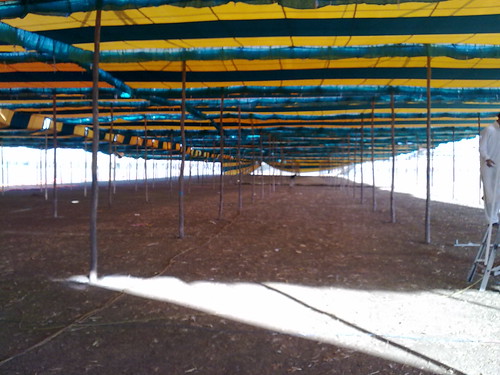
The huge main “pandal” is coming up on about 25 acres of land to accommodate the Jamaats (Groups ofdevotees) from all over India. In the main “pandal” several lakh people will camp for three days listeningto the holy sermons of Islamic scholars as how to inculcate the good values in life following the Islamictenets in order to lead an upright life in this world and thereby be rewarded with Jannat-ul-FirdausHereafter.
On the second day separate special religious discourses will be held during the conclave for intellectuals,traders, farmers, students etc. and the participants would be asked to follow the Islamic religious tenets intheir spirit apart from the message for universal brotherhood. Prominent “Akabreens”(Tableeghi elders)who will address the gatherings include: Maulana Zubair, Maulana Sa’ad, Maulana Yunus, MaulanaAhmed Laat, Maulana Yousuf, Prof. Nadir Ali etc.
Special arrangement for the deaf and dumb
Meanwhile, a special feature of the Ijtima is special arrangements for deaf and dumb people who come inJamaats from all over the country and are housed separately. The sermons from the main “pandal” aretranslated to them in sign language. Their disability does not come in their way to leave their home andhearth to learn and inculcate the basic teachings of Islam to become righteous Muslims.
Mass marriage
Hundreds of couples will get married during the Ijtima when mass Nikaah will be performed in a simplemanner in the spirit of Islam by the elders of the Tableeghi Jamaat.
According to Mr Ateeq-ul-Islam, spokesman and member of the organizing committee of the TableeghiIjtima foreign delegates from 20-25 Muslim countries and the West are likely to join the congregation. TheJamaats from foreign countries will be housed in specially erected tents furnished with all moder facilities. Jamaats from Russia, Cambodia, Indonesia, Malaysia and Sri Lanka have already arrived in thecity and from many more other countries are expected to reach before the commencement of the Ijtima.
Mr Ateeq told this Correspondent that the preparations are in the final stages and all arrangements shall be complete by December 22 and the Jamaats would start arriving at the site of the Ijtima on December 24.
Security measures
He also informed that extra security measures are being taken with nothing being left to chance. While within the Ijtima campus Tableeghi Jamaat volunteers will keep a tight vigil on security while outside and around the Ijtima venue the cadres of Madhya Pradesh Police will do their job of maintaining law and
order. In a bid to boost security in and around the venue CCTVs are being installed at strategic points.
Police have set up watchtowers and hundreds of policemen will be present on the spot. Apart from police, the personnel of Rapid Action Force, (RAF), the Traffic police will be in attendance along with hundreds of volunteers of Tableeghi Jamaat to streamline the vehicular traffic. Special buses will be plying between the Capital and Eintkhedi village to take citizens to the venue.
CM reviews preparations
Meanwhile, Bharatiya Janata Party ruled Madhya Pradesh Chief Minister Shivraj Singh Chouhan while reviewing preparations of the Ijtima at a meeting instructed officials to make elaborate arrangements for the forthcoming religious conclave.
Addressing the officials, Chouhan said that best possible arrangements should be ensured for the visiting Jamaats and directed officials of the Bhopal Municipal Corporation, (BMC), to repair the roads, which connect the city to the Ijtima venue at Ghasipura-Eintkhedi.
BMC officials informed that better facilities were being arranged at the event site with the budget of Rs. 23 lakh. The officials of PWD told the meeting that repair work for 22 sq km road falling in the Ijtima area, has been undertaken with the cost of Rs. 1.74 crore. MP State Electricity Board officials informed that 200 KVA supply is being ensured at the site.
Medical facilities would also be made available at the Ijtima site and ambulances with all the necessary health care equipments would be stationed at the event site. Railway officials informed that a computerized reservation centre would be established for the visitors and additional coaches would be attached to various trains.
It may be recalled here that the Ijtima was first organized at Masjid Shakoor Khan in the walled city in 1948.

UNIVERSE TO END IN FIVE BILLIONS YEARS: SCIENTISTS

Justify FullNov 01, 2010: The prediction comes from the theory of eternal inflation, which says our universe is part of the multiverse.
The problem with a multiverse is that anything that can happen will happen an infinite number of times, and that makes calculating probabilities-such as the odds that Earth-size planets are common-seemingly impossible.
"Normal notions of probability-where you say, Event A happens twice and Event B happens four times, so Event B is twice as likely-don't work, because instead of two and four, you have infinity," National Geographic News quoted Ken Olum of Tufts University in Massachusetts, as saying.
And calculating probabilities in a multiverse wouldn't just be a problem for cosmologists.
"If infinitely many observers throughout the universe win the lottery, on what grounds can one still claim that winning the lottery is unlikely?" theoretical physicist Raphael Bousso of the University of California, Berkeley, and colleagues wrote in the new study.
Universe to end in 5 billion years, predict scientists
Physicists have been circumventing this problem using a mathematical approach called geometric cutoffs, which involves taking a finite swath of the multiverse and calculating probabilities based on that limited sample.
But in the new paper, Bousso's team noted that this technique has an unintended and, until now, overlooked consequence.
"You cannot use [cutoffs] as mere mathematical tools that leave no imprint.
"The same cutoff that gave you these nice and possibly correct predictions also predicts the end of time," said Bousso.
In fact, many physicists think eternal inflation is a natural extension of the theory of inflation, which solved some of the problems with the original big bang theory.
Eternal inflation is a next step in inflation theory, and it allows scientists to avoid some other tricky cosmology questions, such as what existed before our universe (answer: other universes) and why our universe appears to have properties fine-tuned for life.
"Although we don't have a theory [to explain the earliest moments of the universe], we have some pretty good ideas about what such a theory would look like ... and these ideas seem to necessarily include other universes," said Charles Lineweaver, an astrophysicist at Australian National University.
Universe to end in 5 billion years, predict scientists
If probabilities are to work in a multiverse, there must be actual cutoffs that bring various universes to their ends, study leader said Bousso.
According to the formulas used to calculate cutoffs, a universe that is 13.7 billion years old will reach its cutoff in about 5 billion years, his team concludes.
For most people, the idea that a mathematical tool could be elevated to a real-world event might seem strange, but there are precedents for it in physics.
Scientists think our sun-now a middle-age star at about 4.57 billion years old-will be reaching the end of its life in about five billion years.
At that point in time, the sun will run out of fuel in its core and will start to shed its outer layers of gas, inflating to become a red giant and ultimately a planetary nebula.
Earth's exact fate during this event is unclear, but few scientists would argue that life on the planet could survive the sun's death.
Source: ANI

THE MESSAGE OF LAILATUL-QADR

By: Bilal Bashir Bhat
Verily! We have sent it (this Quran) down in the Night of Lailatul-Qadr. And what will make you know what the Night of Qadr is? The Night of Lailatul-Qadr is better than a thousand months. Therein descend the angels and the Rooh (i.e. Gabriel) by Allah’s Permission with all Decrees, Peace! Until the appearance of dawn." (97: 1-5)
The term Lailatul-Qadr is made of two words. In Arabic, Lailat means night and Qadr means honour and dignity. Therefore, the term Lailatul-Qadr refers to the night of honour and dignity. It is this night in which the first Divine Revelation came to the Prophet (PBUH), when he was in meditation and prayer in the Cave of Hira, Mecca. Since this night enjoys the honour of having the first revelation brought to the Prophet (PBUH), it has been named Lailatul-Qadr r.
This is one of the holiest and most blessed nights, which is likely to occur on one of the odd nights on the last ten days of Ramadhan, most likely to be the 27th. The reward of worship on this night is better than the worship of a thousand months of worship, equivalent to a person’s lifetime. So, on this night one should perform the night prayers, recite the Quran, do much remembrance of Almighty Allah, make duas as much as possible and send blessings to Prophet Muhammad (PBUH).
"The person who offered prayers to Allah in the night of Dignity with faith and with hope of reward from Allah, all his past sins have been forgiven." (Bukhari)"Seek the night of Dignity in the odd nights of the last ten days of Ramadhan." (Bukhari)
By odd nights, the reference is made to the 21st, 23rd, 25th, 27th, 29th night of the month of Ramadhan. No one night has been fixed so that the yearning to find it may increase and people may spend more nights in worshiping Allah. From this aspect, the importance of ‘Itikaaf (seclusion) during the last ten days of Ramadhan is clear.
Let us seek abundance rewards from our Creator by performing extra actions in these last few days of the noble month of Ramadhan as it could be our last Ramadhan of our life.
One who misses this blessed night then he has missed much good for no one misses it except one from whom it is withheld. Therefore it is recommended that the Muslim who is eager to be obedient to Allah should stand in Prayer during this night out of Iman and hoping for the great reward, since if he does this, Allah will forgive his previous sins.
Prophet Muhammad (PBUH) said: "Whoever stands in (Prayer) in Lailatul-Qadr out of Iman and seeking reward then his previous sins are forgiven." (Bukhari)
It is recommended to supplicate a great deal in it, it is reported from A’shah, (May All pleased with her) that she said: "O Messenger of Allah! What if I knew which night Lailatul-Qadr was, and then what should I say in it?" He said: Say: "Allaahumma innaka ‘affuwwun tuhibbul ‘afwa fa’fu ‘annee." (O Allah you are the one who pardons greatly, and loves to pardon, so pardon me.) (Tirmidhi, Ibn Majah)
May Almighty Allah forgive all of our sins on the occasion of this coming Lailatul-Qadr.

NIGHT JOURNEY AND ASCENSION OF PROPHET MUHAMMAD (PBUH)

By: Bilal Bashir Bhat
Prophet Muhammad (SAW) had been preaching for a number of years before this wonderful incident of nightly journey and took place. The journey refers from Makkah to Baitul Muqqadis or Masjidil Aqsa as alluded to in Surah Isra or Bani Israel Verse number 1 Glorified be He (Allah) Who transported His messenger for a Journey by night from the Sacred Mosque [Masjidil Haram] to the Farthest Mosque [Masjidil Aqsa] whose surroundings We have blessed in order that We might show him (the Messenger) some of Our Signs.
This incident of journey has a great significance, in the sense that it confirms and explains some of the basic tenants of Islam.This, confirming the existence of heaven and hell and the Final Judgment, reward and punishment, recounts the genesis of the basic worship [Salat] five times a day, and a number of other aspects of blessings from Allah (SWT) showered on Muhammad (SAW) and his community of Muslims.
One night, it was a Monday night, the Prophet was staying at Um-Hany's house. The prophet had been brought up in the family of Abu Talib and after the Prophet's marriage to lady Khadijah (RA) Ali (RA) used to live with him. Abu Talib's wife Fatimah and her daughter Um Hani were among the first Muslims. Um Hani was the daughter of Abu Talib and sister of Ali and Jaafar. Um Hani's husband Hubayrah was not a Muslim, but he respected the family relationship and the fact that they had accepted Islam. He made the Prophet (SAW) feel welcome at his house and did not oppose his family members using his house as a place of retreat for the Prophet (SAW).
The Messenger of Allah (SAW) is reported to have said that he was awakened by the angel Jibra'eel (AS). His heart was cleansed, and Buraq (which in Arabic means the Lightening), a heavenly beast, was brought for him to ride. Jibraeel (AS) said, "Ride, so we can go."
"Where to?" asked the Prophet.
"To your Lord," said the archangel.
On the Way to the Masjidil Aqsa:
Praying at Other Holy Places
As the journey continued, first they halted at Yathrib and prayed two rakats of prayer. The Prophet was told that he would be migrating to this place. Then they stopped at Madyan and the Mount of Sinai and the Bush of Moosa (AS), and Baithelhem the birthplace of 'Isa (AS) and said two raka'ats of prayer at each place.
Choosing the Natural Religion
Then the prophet felt thirsty and three cups were brought to him: one had honey in it, the other milk, and the third wine. The Prophet (SAW) chose milk and he was congratulated by the angel for the choice of the natural in his religion. He was told he and his people would remain firm on the natural ways.
In the Baitul Muqaddis (The Sacred House In Yerusalem):
The Prophet Is Greeted By the Angels
Then they reached Baitul Muqaddis where he was greeted by angels who were saying,
"Asalam 'alaika Ya Awal, Ya Aakhir, Ya Haashir."
The angel explained to the Prophet (SAW) that he was being greeted as Awal the First [Aakhir] the last and [Haashir] the gatherer because he would be the first to rise on the day of resurrection and the first intercessor [shaafi'] and the first [Mushfi']; and he was the last of the Prophets and he would be the gatherer [Haashir] of communities on the day of Judgement.
The Prophet is greeted by the Earlier Prophets
Then they entered the Mosque where he was received by the Prophets before him-- from Idris and Nuh to 'Isa [Alaihimissalam]. They also greeted him with the same greeting as did angels, "Assalam Alaik Ya Awwal, Ya Aakhir, Ya Haashir."
The Prophet Is Asked To Lead The Prayers
The Prophets stood in rows and Muhammad (SAW) was asked to lead them in prayer. The gathering of the prophets and Muhammad (SAW)'s leading the prayer was to indicate that Muhammad (SAW) had brought no religion other than the one practiced and approved by the prophets before him and that he was to perfect their religion and be its final Messenger.
Ascending To Skies
Then the Prophet (SAW) and Jibraeel (AS) came out of the Mosque and in the company of Mikaeel (AS) and other angels they headed for the seven skies. They were allowed to enter each heaven after the archangel had responded to the enquiries regarding his companion and whether he had been sent for. In the first and the seventh sky, the Prophet was greeted by Adam and Ibraheem (Alaihimassalam) who greeted him addressing him as Pious or Right-Acting Prophet and Pious Right-Acting son and said, "How blessed is your arrival here!"
From the second to the sixth sky, the Messenger of Allah (SAW) met 'Isa and Yahya, Yusuf, Idris, Haroon, and Moosa Alaihimissalam who greeted him addressing him as Pious Right-Acting Brother and Pious Right-Acting Prophet and they said, "How blessed or blissful is your arrival here!" They said,
The Meeting With Allah (SWT)
The archangel Jibraeel (AS) stopped at the Sidratul Muntaha and the Messenger of Allah was brought into the Presence of Allah (SWT). During this Meeting with His Lord, Muhammad (SAW) was greeted with the greetings of peace: [Attahayyatu lillahi Assalat wat-tayyebaat Assalamu 'Alaika Yaa Ayuhan-nabi]. There the Prophet (SAW) saw what he saw. His heart did not lie about what he saw. The eyes did not waver. And Allah revealed to the Messenger what He revealed. Then he drew nearer until Allah SWT says, "He drew nearer" and "He was at two-bows' length or even nearer."
Qadhi Iyad reports Mawardi who said, "It is said that Allah (SWT) divided His vision and His speech between Musa (AS) and Muhammad (SAW). Muhammad (SAW) saw Him twice and Allah (SWT) spoke directly to Musa (AS) twice." On his return, Prophet Moosa (AS) made Muhammad (SAW) go back to his Lord five times with regard to reducing the number of the prayers until it came down to five from fifty.
Then the Prophet (SAW) was asked to speak. The Messenger of Allah glorified Allah (SWT) and recounted the blessings Allah (SWT) had bestowed upon His prophets before him. Then Allah (SWT) addressed His Messenger and said,
"I have taken you as a close friend and as a beloved.
I have had it written in the Toraat that "Muhammad is the beloved of the Merciful."
I have sent you to all mankind.
And I have made your community such that none shall be permitted to speak until they have testified that you are My servant and My Messenger.
I made you first of the Prophets to be created and the last of them to be sent.
I gave you Surah Al-Fatiha
I gave you the seals (the last three verses) of the Surat al-Baqarah from a treasure under My Throne, and I did not give them to any prophet before you.
I made you an opener and a seal."
Thus what was awarded to the Messenger of Allah on this day included presents the likes of which no prophet was given before him: the power of intercession for the pardon for the major wrong actions of everyone of his community who did not associate anything with Allah and five prayers a day.
Witnessing the People In the Hell and the Heavens
Then Muhammad (SAW) was shown both the hell and the heaven. In the hell were the eaters of the properties of orphans and the eaters of usury, adulterous men and women, killers of children, back-biters, slanderers, and many others. Muhammad (SAW) was also shown the Jannah. He saw the Jannat of Zaid bin Haritha, Umar Ibn Khittab, and heard the sound of Bilal's footsteps in one of the Jannats. The details are narrated in a number of traditions.
The Return Journey
It is reported that after the visit of the seven Skies, Jibraeel 'Alaihissalam brought Muhammad (SAW) back to Masjidil Aqsa from where they returned to Makkah. During their return journey, the Prophet (SAW) saw two caravans heading for Makkah at certain distance from one another.
Before departing from Allah's Messenger, Jibraeel (AS) asked the Prophet to inform the people about this incident. The Prophet expressed his fear that people would not believe him. The Prophet (SAW) said, "O Jibraeel, my people will not confirm it." Jibraeel (AS) said, "Abu Bakr (RA) will testify it and he is As-Siddiq."
Prophet Narrates the Incident to Abu Jahl & Other Kuffaar of Makkah
The Prophet was sitting by Hijr in the Mosque when Abu Jahl passed by and asked mockingly what new thing he had brought to say that day. The Messenger of Allah (SAW) told him about the nightly journey to Baitul Muqqadis. Abu Jahal was delighted to find such a wonderful occasion to mock the Prophet, so he asked him if he would narrate that story in front of others. When the Prophet said he would, Abu Jahal went and brought a huge crowd of the Quraish to the mosque to hear the Prophet's story.
The Prophet Describes Baitul Muqqadis to the Quraish
Ibn Isahaq said, when the Prophet (SAW) told them the story most of them said, "By Allah this is a plain absurdity. A caravan takes a month to go to Syria and a month to come back. How can Muhammad (SAW) do the return journey in one night?" This was like it would have been difficult a hundred years ago to believe that a man can take that same journey in an aeroplane in an hour's time; but today we know such a journey is possible in an hour. So the Quraish of Makkah asked the Prophet (SAW) to describe the Masjid al-Aqsa to them. Jabir Bin Abdallah reports how Allah's Messenger (SAW) used to describe this event. Allah's Messenger (SAW) used to say, "When the people of Quraish did not believe me, I stood up in Al-Hijr and Allah (SWT) put (displayed) Baitul Muqaddis in front of me, and I began describing it to them while I was looking at it."
There were, among the audience, quite a few persons, including Abu Bakr (Radi-Allah 'Anhu) who had seen the mosque. As the others heard the description of the Masjid with their mouths open in amazement, Abu Bakr kept testifying that what the Prophet was saying was correct. Finally, among the people sitting there, Abu Bakr said, "That is true and I testify that you are the Messenger of Allah and His Servant." Thereupon Jibraeel (AS) brought the revelation, "
And he who has come with the Truth and the one who confirms him true they are the God-fearing. (Az-Zumur: 39:33)
Abu Bakr (RA) was given on that day the title As-Siddiq-- the True, the Confirmer of the Truth. The Prophet (SAW) also told the Quraish about the two caravans which were soon to arrive. Then when the caravans did arrive, they found all the details to be just as the Messenger of Allah had informed them.

(ZINA) ADULTERY IN ISLAM

By: Bilal Bashir Bhat
Islam has taken a firm and decisive stance against Zina (fornication or adultery). Allah, the Almighty, commands in explicit and unequivocal words: "Do not go near to adultery. Surely it is a shameful deed and evil, opening roads (to other evils)" (Quran 17:32).
Thus, Islam not only prohibits Zina, but also closes all the avenues and means leading to it. This is achieved by prohibiting every step and means leading to stimulating desires, opening ways for illicit sexual relations between men and women, and promoting indecency and obscenity.
"Say, 'Verily, my Lord has prohibited the shameful deeds, be it open or secret, sins and trespasses against the truth and reason"' ( Quran 7:33).
"Women impure are for men impure, and men impure are for women impure and women of purity are for men of purity, and men of purity are for women of purity." (Quran 24:26)
Prophet Muhammad (PBUH) has said in many places that adultery is one of the three major sins. However, the most interesting story is that of a young man who went to the Prophet. This man asked for permission to fornicate because he could not control himself. The Prophet dealt with him with reasoning and asked him if he would approve of someone else having illegal sex with his mother, sister, daughter, or wife. Each time the man said 'no'. Then the Prophet replied that the woman with whom you plan to have sex is also somebody's mother, sister, daughter, or wife. The man understood and repented. The Prophet prayed for his forgiveness.
Adultery is a crime not against one person but against the whole of society. Does it mean that not only is illegal sex prohibited, but also anything that leads to illegal sex is also illegal? These things include: dating, free mixing of the sexes, provocative dress, nudity, obscenity, masturbation and pornography. The dress code both for men and women is to protect them from temptation and desires by on lookers who may lose self-control and fall into sin. "Say to the believing men that they should lower their gaze and guard their modesty; that will make for greater purity, and God is well acquainted with all they do. And say to the believing woman that they should lower their gaze, and guard their modesty."(Quran 24:30-3 1)
The Prophet (peace and blessings be upon him) said, “O mankind! Beware of fornication/adultery for it entails six dire consequences: three of them relating to this world and three to the next world. As for the three that are related to this world, they are the following: it removes the glow of one’s face, brings poverty, and reduces the life-span. As for its dire consequences in the next world they are: it brings down the wrath of Allah upon the person, subjects him to terrible reckoning, and finally casts him in hell-fire”

Visitors: